
Fox Opinion: Hey, Christian Bale, Dick Cheney's my former boss. Here's what your Golden Globes speech missed.
These elites live in a warped and entitled bubble, where “their truth” is to be imposed as “the truth” on all of us dim and dirty deplorables. As they gather for these celebrations of their collective narcissism, perhaps they forget that beyond the room full of their kind of people (who think Satan is funny and Republicans are evil) lies a large, fruited plain of people who think, believe and live differently.
If we deplorables wise up and stop paying to be insulted by them, their glorious bubble will get a lot smaller.
Steve Yates wrote the following piece for Fox Opinion:
By now the whole world has heard one of the more unusual “thank you” speeches delivered by an award-winning actor.
Last night, for his depiction of former Vice President Dick Cheney in the movie “Vice,” Christian Bale received the Golden Globe award for best actor in a comedy or musical.
In his acceptance speech he thanked "Satan" for giving him inspiration for how to play the role. And for good measure, Bale added that the role set him up to corner the market on depicting “charisma-free a** holes” who are “reviled by everybody.” For his next role he suggested playing Republican Senate Majority Leader Mitch McConnell.
First I must say, I was intrigued that someone won an award for playing my former boss in a comedy or musical. Having spent some time around him I can safely disclose that Dick Cheney does in fact have a sense of humor. It’s pretty sharp, and he is not averse to self-deprecation.
Second, I must confess that I am impressed by the physical transformation that truly gifted actors undergo in order to take on another persona – especially one of an iconic figure. On that score, Bale did a remarkable job.
But that is where the good news ends for the actor and his Golden Globe comedy routine.
Tsk, tsk. What’s a guy named Christian doing consulting with Satan? That just doesn’t seem right. And come on, if you are going to roast an immensely intelligent and experienced person with whom you disagree, shouldn’t the bar be a bit higher than just calling him a “charisma-free a** hole”? Perhaps Christian should consider better sources for inspiration.
Then again, this is what we have come to expect from our entertainment elite. After all, it wasn’t that long ago that Robert De Niro graced the 2018 Tony Awards with the deep philosophical words “F**k Trump!”
These elites live in a warped and entitled bubble, where “their truth” is to be imposed as “the truth” on all of us dim and dirty deplorables. As they gather for these celebrations of their collective narcissism, perhaps they forget that beyond the room full of their kind of people (who think Satan is funny and Republicans are evil) lies a large, fruited plain of people who think, believe and live differently.
If we deplorables wise up and stop paying to be insulted by them, their glorious bubble will get a lot smaller.
Really though, the most disappointing thing about Bale’s acceptance speech was that he simply went for base humor and coarse language, sure to align with the culture and ideology of his peers, and just left it at that.
While there is a healthy dose of revisionist liberal bunk in the movie (especially for those of us who lived a part or two of the story), Bale must have discovered things about Cheney that even he could admire – a man who married a talented, strong and accomplished woman who essentially saved and shaped his life; an unmatched career at the highest levels of leadership from the White House to Congress to the Pentagon to the private sector and back to the White House; a front row seat to many of the most consequential challenges facing our nation and the world.
While it may be too much to ask for Hollywood to give credit where credit is due – and perhaps doing so would have been less entertaining for some – surely Bale could have shared a morsel or two about what surprised him in taking on this role, given the consequential life he was depicting (and then mocking). That would have at least added a little value to his speech, and maybe even convinced a few outside of that bubble to tolerate watching his movie.
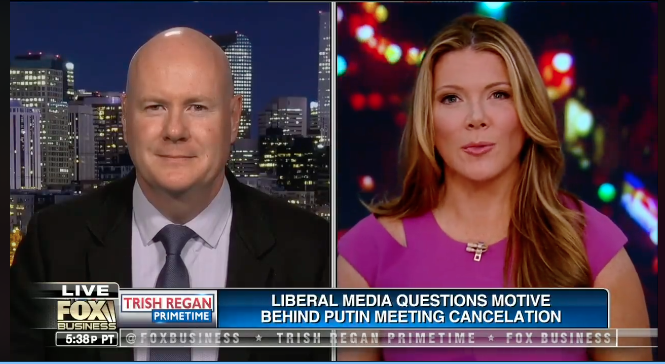
Steve on Trish Regan Primetime
I joined Trish Regan on Fox News to discuss the canceled meeting between President Trump and Vladimir Putin at the G20.
Steve on After the Bell
Steve joined After the Bell to discuss interaction between world leaders at the G20 summit in Argentina.

Steve on the Ingraham Angle
Steve joined Laura Ingraham Angle weighed in on how Trump should address the US-China deal.
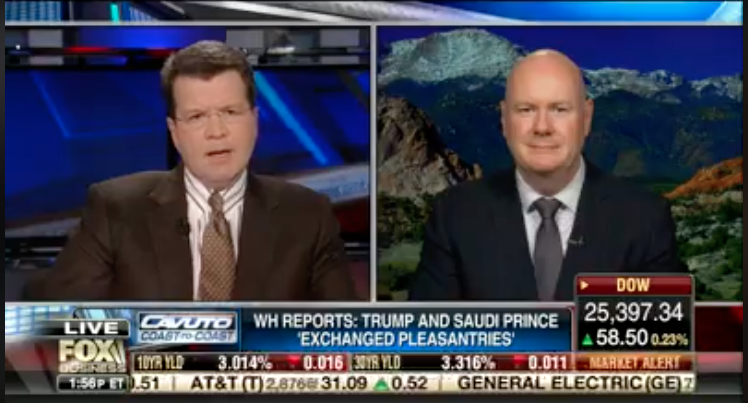
Steve on Cavuto Coast to Coast
Steve joined Cavuto Coast to Coast to discuss the first day of the G20 Summit, and what to expect from President Trump’s meeting with President Xi.
Steve on NTD TV's Zooming In with Simone Gao
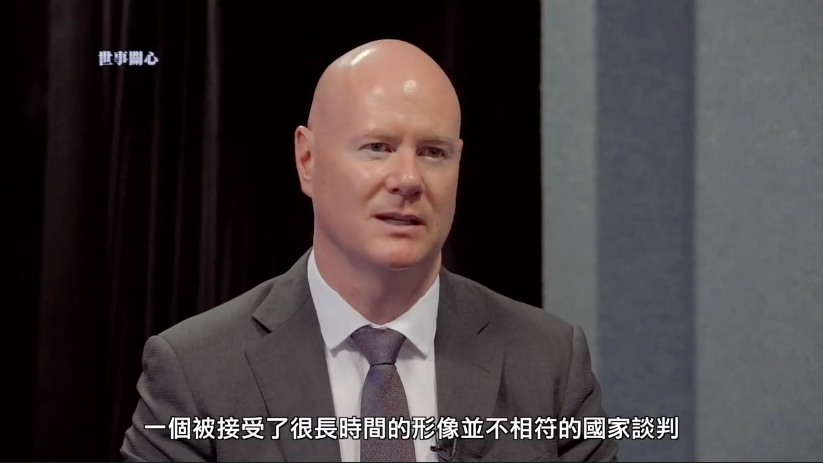
Steve Yates joined New Tang Dynasty TV’s Zooming In with Simone Gao to discuss United State’s relations with China under the Trump administration. You can watch the full interview here.
Pence in Asia: A Strategically Significant Week for the US, Taiwan, and China
Readers in Taiwan are understandably consumed with constant coverage of the important May 24 elections. It would be a mistake, however, to miss the significant, even historic, developments that unfolded over the course of US Vice President Mike Pence’s visit to Asia.
This article first appeared in Taiwan’s Do Post.
Readers in Taiwan are understandably consumed with constant coverage of the important May 24 elections. It would be a mistake, however, to miss the significant, even historic, developments that unfolded over the course of US Vice President Mike Pence’s visit to Asia.
According to the Vice President’s spokesperson, Pence’s objectives for this visit were to “reaffirm the President’s commitment to the final, fully verified denuclearization of the Korean Peninsula... [and] deliver the message that authoritarianism, aggression, and the disregard for other nations’ sovereignty by any nation in the Indo-Pacific will not be tolerated by the United States.” And he certainly did as promised.
Vice President Pence has proven to be authoritative and effective in articulating a restoration of realism in the US approach to China. His speech at the Hudson Institute together with his remarks at the APEC Summit offer a comprehensive assessment of the challenges posed by China and strategic case for cooperation with America.
With clarity and firmness, Pence summed up the value proposition to Asia-Pacific leaders as follows:
“Know that the United States offers a better option. We don’t drown our partners in a sea of debt. We don’t coerce or compromise your independence. The United States deals openly, fairly. We do not offer a constricting belt or a one-way road. When you partner with us, we partner with you, and we all prosper.”
How did China respond? With “tantrum diplomacy” as Washington Post columnist Josh Rogin put it in his compelling assessment of the APEC summit. They bullied the host nation. Allegedly, they interfered with journalists’ ability to cover the Pence speech. And they forced the summit to conclude without a communique for the first time, by refusing to join all others in agreeing to “fight protectionism including all unfair trade practices.”
In short, China showed its true colors under the leadership of Xi Jinping and the Chinese Communist Party. Rogin put it well, “This is what the Chinese government is today: pushy, insecure, out of control and with no desire to pretend anymore they will play by the rules the international community has been operating under for decades.”
As the Trump and Xi approaches to Asia collided at APEC, others may have been concerned about collateral damage. As the old African proverb goes, “When elephants fight, it’s the grass that suffers.” However, in this case, Chinese “tantrum diplomacy” actually encouraged more substantive bilateral meetings between Vice President Pence and other APEC delegation leaders, including Morris Chang of Taiwan.
Given that Taiwan is a full member of APEC, with rights equal to other members, it was not surprising the Vice President would take such a meeting. Morris Chang’s professional background made him uniquely suited to address intellectual property rights (IPR) protection as well as the broader challenges posed by Communist China as outlined in Pence’s remarks.
According to the Vice President, the conversation was about economics and trade. This Administration has proven they are committed to doing what is in the best interest of the United States - including the potential for a bilateral trade agreement with Taiwan.
While meetings between delegation leaders at APEC should be routine, given the “Orwellian nonsense” that is China’s effort to pretend Taiwan is subordinate to its sovereignty, it was an important step forward for a sitting Vice President of the United States to meet with Taiwan’s head of delegation at APEC.
As Taiwan voters go to the polls this Saturday, they do so in the context of a changing Indo-Pacific region. Thanks to China’s “tantrum diplomacy” it stands apart from all other APEC members. Thanks to Vice President Pence, the people of Taiwan have been treated with dignity and their substantive proposal for a bilateral trade agreement will be presented to President Trump for consideration. All in all a very good week for the interests of the Taiwanese people as they contemplate continuity vs. change in this weekend’s elections.
On Fox Business' The Evening Edit
Steve joined The Evening Edit to discuss Chancellor Angela Merkel’s ‘pan-European Army.’ Catch the clip below!

The Democrat Blue Wave vs The Trump Red Wall
With the results now in for yesterday’s election in the United States, an abundance of experts and commentators will wax poetic on what it all means. Republicans claim victory based on Senate gains, and Democrats claim victory based off the House. Simply put, based on historical expectations for this kind of midterm election, the outcome was very good for President Trump.
This article first appeared in Taiwan’s Do Post.
With the results now in for yesterday’s election in the United States, an abundance of experts and commentators will wax poetic on what it all means. Republicans claim victory based on Senate gains, and Democrats claim victory based off the House. Simply put, based on historical expectations for this kind of midterm election, the outcome was very good for President Trump.
Americans elect presidents based on the majority vote within each state, and this election, President Trump consolidated and even expanded his Electoral College advantage heading into his 2020 re-election. Senate victories in important electoral states like Florida, Ohio and Missouri provide an important approximation of where voters stand. Adding Senate seats in key states is a victory of historic proportions for the first midterm of a new US Presidency.
Democrats will claim as victory gaining the majority in the House and in several state leadership positions, and while they did gain ground, it was to be expected based on historical models. What is important is their gains did not amount to the “blue wave” rebuke of President Trump many experts and politicians predicted.
While the results of this election can tell you a great deal about the American electorate and the direction of our country, when it comes to United States relations with Taiwan, there will remain more continuity than change. The Senate continues to be held by Republicans, and action on American foreign policy -- such as treaties and personnel -- remains strongly within the Senate’s purview. The change in House leadership is likely to be felt much more in areas beyond foreign affairs, and may even lead to more bipartisanship on the challenges posed by China and the opportunities presented by Taiwan.
In 2016, then-candidate Trump ran, and won, on a few simple promises: fair trade for the United States, pushing back against China, investing in infrastructure, and building a border wall. With the midterm past, and as President Trump turns his attention to his re-election campaign, he is likely to double down on these same promises, returning to the issues that helped Republicans win in 2016. Aside from the politics of the border wall, the President may find more agreement than pushback from Democrats in the new Congress.
This means President Trump is likely to continue to promote bilateral over multilateral initiatives, especially with regard to treaties, trade and arms sales. He will continue to implement policies that strengthen the United States economy, meanwhile putting the pedal to the metal on the trade war with China.
Even more than after the 2016 election, American voters, elected officials and our allies have a broader understanding of the threat that China poses. Republicans and Democrats alike see the threat of intellectual property theft, corporate espionage, forced technology transfer and currency manipulation.
With Democrats in control of the House, there is an opportunity for them to re-discover their roots as human rights and labor advocates. With China’s increased economic aggression and very troubling human rights violations, Taiwan is a bipartisan partner to turn toward. Likely Democrat Speaker of the House Nancy Pelosi has spoken publicly about China’s human rights violations regarding Tibet, recently saying, according to Reuters, “They (the Chinese) have to recognize that there’s a value to them in letting Tibet be Tibet in an autonomous way.” These same sentiments can, and do, ring true regarding Taiwan.
Also worth noting, is the changeover in the Senate Foreign Relations committee. With the retirement of current Chairman Bob Corker, Idaho Senator Jim Risch is in line to take over as Chairman of the Foreign Relations Committee. Taiwan is Idaho’s third largest trade partner (behind Canada and Mexico, and before China) and Idaho-based Micron Technology is the single largest foreign direct investor in Taiwan. While any Senator faces a great deal of pressure from lobbyists and organizations in D.C., the group they are most accountable to is their voters - and many of Idaho voters care a great deal about their trade relationship with Taiwan.
While the rest of the world is looking at the election as a referendum on President Trump, for Taiwan, it represents a great opportunity to increase bilateral relations with the United States. America’s relationship with Taiwan is not dependent on which party is in power. The China threat is real, and Taiwan’s status as a free and democratic society rings true with key leaders and a majority of voters in both political parties.
Taiwan, Micron, and China’s Economic Theft
This last week, United States Department of Justice and Taiwanese Ministry of Justice cooperated to indict United Microelectronics Corp., China state-owned Fujian Jinhua Integrated Circuit Co. Ltd and three former Micron Technologies employees.
This is just the most recent example of China’s drive to dominate global economics and technology. Above all, it shows the sad truth of the lengths China will go to steal intellectual property. China’s “Made in China 2025” initiative should be of concern not only to the United States and Taiwan, but to every country around the world that values their intellectual property.
This article first appeared in Taiwan’s Do Post.
This last week, United States Department of Justice and Taiwanese Ministry of Justice cooperated to indict United Microelectronics Corp., China state-owned Fujian Jinhua Integrated Circuit Co. Ltd and three former Micron Technologies employees.
This is just the most recent example of China’s drive to dominate global economics and technology. Above all, it shows the sad truth of the lengths China will go to steal intellectual property. China’s “Made in China 2025” initiative should be of concern not only to the United States and Taiwan, but to every country around the world that values their intellectual property.
If China’s goal was to simply bolster their economy through technological development, that would be one thing. Instead, as Vice President Pence recently pointed out in a speech to the Hudson Institute, “to win the commanding heights of the 21st Century economy, Beijing has directed its bureaucrats and businesses to obtain American intellectual property – the foundation of our economic leadership – by any means necessary.”
The most recent charges are just one example of China’s ‘by any means necessary’ policy, but more than that, it is a positive example of what can be done between the United States and Taiwan to effectively lead the international response to deter the Chinese Communist Party’s ongoing economic theft.
The immediate and proactive cooperation by the Government of Taiwan in bringing these individuals and those they represent to justice was an incredibly important sign. More than any other country, Taiwan knows the nature and scope of the CCP’s efforts to infiltrate democratic countries with the aim of stealing talent and intellectual property and influencing their politics. This example of cooperation is a strong demonstration of the potential for Taiwan and its international partners to cooperate and share best practices in meeting this challenge.
This was a win for the United States and Taiwan, but make no mistake, the challenge posed by the CCP is as extensive and broad as laid out by Vice President Pence. What makes the threat unique is the extent to which they are challenging all free societies and economic competitors through international institutions, within China, and even within our own countries. As the international community increasingly becomes aware of the nature and scope of this challenge, Taiwan will have a unique opportunity to enhance its international position, escaping the CCP’s squeeze on Taiwan’s international space.
These recent events demonstrate the positive value of cooperation between the United States and Taiwan, but also underscore the risks to Taiwan and its citizens if they are perceived to have too close an association with China. Because of the kind of activity involved in this Micron case, much of the international community is seeing China in an increasingly negative light. To the extent that Taiwan is mistaken as being a part of China (a false impression reinforced by international media, government officials, supposed experts and the name “Republic of China”), Taiwan runs the risk of being perceived as a part of the problem rather than a part of the solution.
It is more important than ever to make clear to the world that Taiwan is Taiwan and not part of China. It is a nation of free and law abiding people, who are willing partners in promoting the prosperity of all who partner with its people. And it will relentlessly protect the intellectual property of all who invest in its companies.
Both the United States and Taiwan need to be vigilant about the threat that China poses. Vice President Pence later said in his speech at the Hudson Institute “We will continue to take action until Beijing ends the theft of American intellectual property, and stops the predatory practice of forced technology transfer.” It is not just American intellectual property that China seeks to steal, and fighting back against their predatory practices is a cause that the United States, Taiwan, and countries around the world can unite behind.